Technology

Better Gas–Water Contact with
Nanobubble Technology

Nanobubbles disperse gas as ultrafine bubbles, increasing gas–water contact for oxygen transfer, ozone oxidation, cleaning, and functional water. Honour Tech engineers systems for real process conditions.

01

What Are Nanobubbles?

Nanobubbles are ultrafine bubbles that rise slowly and remain dispersed longer, increasing gas–water contact.

Nanobubbles are gas bubbles smaller than 1 μm in diameter, also referred to as ultrafine bubbles.
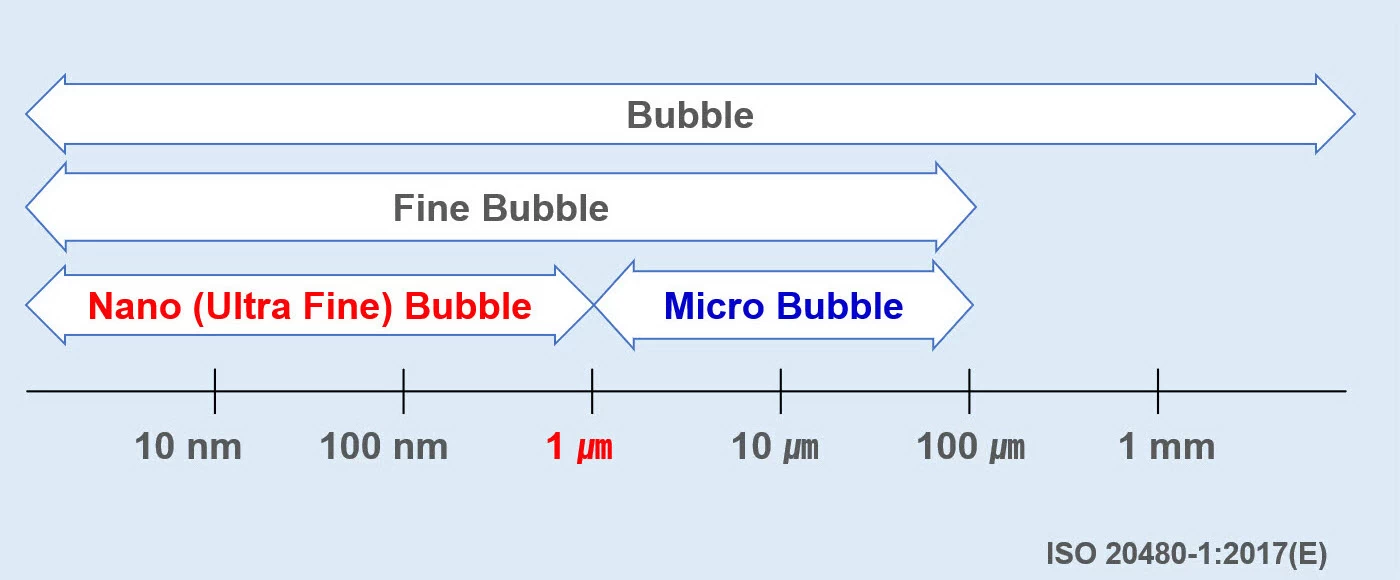
Size comparison of conventional bubbles, microbubbles, and nanobubbles based on ISO 20480-1:2017

Bubble-size ranges (Source: ISO 20480-1:2017)

Larger Interfacial Area

Smaller bubbles create more gas–water interface, supporting gas transfer.

Brownian Motion

Their small size and irregular motion help them remain dispersed longer than larger bubbles.

High Oxygen-Transfer Efficiency

Small bubbles and longer contact can improve oxygen transfer. One Honour Tech test measured ~90% efficiency under specific conditions.

Surface Charge

Surface charge may influence fine particles and contaminants, supporting separation under suitable water and process conditions.

02

Small Bubbles, More Contact Time

Performance depends on the gas, process, and operating conditions—not bubble size alone.

Conventional Bubbles

Rise quickly to the surface, limiting gas–water contact time.

Nanobubbles

Remain dispersed longer and provide a larger interface, supporting gas transfer.

01 · GAS TRANSFER Transfer O₂, O₃, CO₂ and Other Gases

  • More gas–liquid contact
  • Dissolved-gas control
  • Target DO control

02 · OXIDATION Support Ozone Contact & Oxidation

  • Reduce organics, color, and odor
  • Advanced oxidation support
  • Lower downstream load

03 · CLEANING Support Cleaning of Surfaces & Fine Gaps

  • Contaminant detachment and dispersion
  • Better washing and rinsing
  • Cleaning in gaps and complex geometry

04 · WATER MANAGEMENT Manage Circulating & Stored Water

  • Increase dissolved oxygen
  • Biofilm and microbial control
  • Circulating/stored water quality

05 · FUNCTIONAL WATER Functional Water with Different Gases

  • Oxygenated, ozonated, and hydrogen-enriched water
  • CO₂-dissolved water
  • Manage target gas concentration
03

Honour Tech Nanobubble Technology

We match gas, water quality, flow, pressure, and existing equipment to build systems for real site conditions.

Gas Selection by Purpose

Air, O₂, O₃, CO₂, H₂, and other gases are selected by process target.

Design for Site Conditions

  • Flow · Pressure · Water Quality
  • Gas · Target Dissolved Concentration
  • Circulation · Existing Equipment Integration

From Generator to Integrated System

  • Bubble mixer · Generator
  • Gas supply · Controls · Tank circulation
  • Integration and operating-condition design

Cleaning-Performance Enhancement

We also combine nanobubbles with pulsed flow to enhance cleaning.

04

Technical Differentiation

Pump and pressure configurations are matched to flow, gas, installation, and process conditions.

Platform Base Configuration Operating Profile Key Applications
SQN Compact SQN + compact pump Low flow · POU Medical waterlines · functional water · lifestyle
HEN Low-Pressure Circulation HEN + submersible/centrifugal pump Low pressure · high-flow circulation Agriculture · water bodies · tanks
HQN Pressurized Modular HQN + pressure pump Pressurized · industrial process Cleaning · water treatment · AOP
Nano Pulse Jet Nanobubbles + Pulse Jet Pulsed-flow cleaning WIP · CIP · process cleaning

01 In-House Core Technology

  • 5 patents (2 registered · 3 pending)
  • Core mixers and systems designed and built in-house

02 Operating-Pressure Optimization

  • From very low to high pressure
  • Matched to pump, flow, and site
  • Existing-equipment integration

03 Generator + Process Integration

  • Beyond stand-alone generators
  • Water quality, flow, pressure, and gas reviewed together
  • Process-integrated system design

04 Validation-Based Application

  • Confirm water quality and target
  • Pilot/comparative tests when needed
05

Application Conditions & Validation

Nanobubbles supplement rather than automatically replace existing processes. Results depend on:

  • Source-water or wastewater quality
  • Applied gas
  • Flow and circulation time
  • Temperature and operating pressure
  • Organic/contaminant load
  • Existing process and performance target

We review process conditions and use lab or pilot tests when needed before system selection.

06
In Development

Future Strategic Technology

We continue to research new generation methods and applications.

01

Next-Generation Nanobubble Generation

Developing a new generation approach.

Small prototype validated
02

CO₂ Dissolution & Utilization

Researching efficient CO₂ transfer and use in water.

R&D in progress
03

Next-Generation High-Cleanliness Precision Cleaning

Researching high-cleanliness cleaning for semiconductor and display processes.

R&D in progress
04

Lifestyle & Wellness Applications

Exploring additional gases and lifestyle/wellness uses.

R&D in progress