
What Are Nanobubbles?
Definition and Key Properties
Nanobubbles generally refer to ultrafine bubbles smaller than 1 μm in diameter. Their size and behavior set them apart from ordinary large bubbles, and they are used in gas transfer and a wide range of water-based processes.
Nanobubble properties start with size
Nanobubbles are called ultrafine bubbles (UFB) in the international standard ISO 20480-1. Because they are so small, they rise slowly and move randomly in water, which can favor contact between gas and water. Actual effects depend on the gas, water quality, generation method and operating conditions.
This page explains, in order, how bubbles are classified by size, their key properties, how they are generated and the role of each gas.
<1μm
Nanobubble diameter
Smaller than one-seventieth of the width of a human hair (about 70 μm). Classification per ISO 20480-1:2017.
-
Frame width 100 μm
Human hair, about 70 μm
-
Frame width 10 μm
Red blood cell, about 7 μm
-
Frame width 1 μm
Nanobubble (dotted circle, below 1 μm)
-
Frame width 100 nm
Nanobubble, about 60 nm
A conceptual illustration zooming in 10× at each frame. Objects are sized to the frame width, and the dotted square marks the area enlarged in the next frame. The nanobubble of about 60 nm is based on the mean diameter in the measurement example below.
Size classification
Swipe left or right to see the full table.
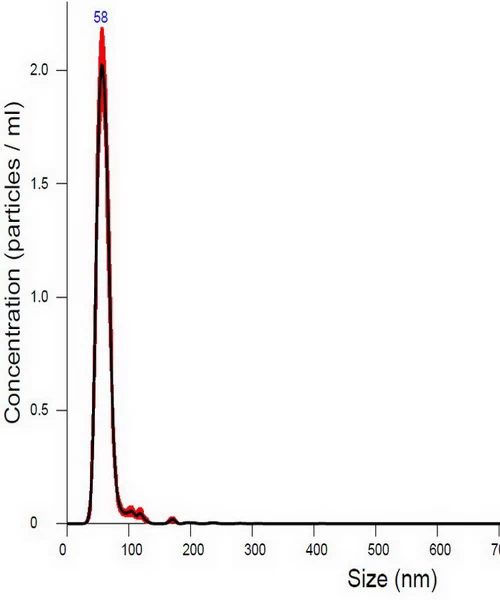
Measurement example: size distribution of nanobubbles we produced
Nanobubbles produced by Honour Tech's laboratory system were measured by nanoparticle tracking analysis (NTA). Most bubbles are concentrated below 100 nm.
- Mean diameter
- 61.9nm
- Mode
- 56.9nm
- D50
- 58.8nm
Measurement conditions NanoSight NTA 3.4 · Laboratory LAB-I · 0.6 m³/h (10 L/min)
This is an example measured under one set of conditions. Size distribution can vary with commercial scale and operating conditions, and analytical instruments cannot fully distinguish bubbles from fine particles.
Differences by bubble size
As bubbles get smaller, buoyancy matters less. For nanobubbles, Brownian motion, the random movement caused by collisions with water molecules, becomes important.
-
Ordinary bubbles
- Size
- 100 μm and above
- In water
- Rise quickly and burst at the surface.
- Typical uses
- Aeration, mixing
-
Microbubbles
- Size
- 1 μm to below 100 μm
- In water
- Rise by buoyancy; light scattering can make the water look milky.
- Typical uses
- Processes that float and separate contaminants
-
Nanobubbles
- Size
- Below 1 μm
- In water
- Rise very slowly and are invisible to the eye.
- Typical uses
- Processes where gas transfer and contact with fine surfaces matter
Conceptual illustration. Bubble sizes are not to scale; the speed of motion represents the difference in rise velocity.
Key properties
Effects are not determined by bubble size alone; they depend on the gas, the process and the operating conditions.
-
Large surface area
Dividing the same volume of gas into smaller bubbles increases the total surface area in contact with water.
-
Slow rise
Because the bubbles are so small, they rise slowly and can disperse and remain in the water.
-
Favorable for gas transfer
A large contact area creates favorable conditions for gas to dissolve in water.
-
Surface charge
The bubble surface can carry an electrical charge depending on water quality, pH and other conditions, which can affect interactions with particles.
Main methods of nanobubble generation
Bubble size distribution, required pressure and treatable flow rate vary with the method. Actual devices often combine two or more methods.
-
Pressurized dissolution
Gas is dissolved in water under raised pressure; when the pressure is released, the dissolved gas comes out as fine bubbles.
-
Swirl and shear
Water and gas are spun rapidly or forced through narrow channels so that shear forces break the bubbles into smaller ones.
-
Cavitation
High flow velocity or ultrasound momentarily lowers the pressure in water to form bubbles.
-
Fine pore method
Gas is forced through a material with very small pores to form small bubbles.
Honour Tech's bubble mixer combines pressurized dissolution with swirl and shear. View Technology & Products
The role depends on the gas
Swipe left or right to see the full table.
| Gas | Main role | Characteristics and considerations |
|---|---|---|
| AirAir | Gas dispersion, oxygen supply | Low oxygen content limits how high dissolved oxygen can go. |
| O₂Oxygen | Dissolved oxygen supply | Used in processes that require high dissolved oxygen. An oxygen supply unit is required. |
| N₂Nitrogen | Reducing oxygen contact and oxidation risk | Considered for processes that aim to limit oxygen ingress. Effects depend on operating conditions. |
| H₂Hydrogen | Functional water production | Hydrogen concentration and gas handling safety must be reviewed. |
| CO₂Carbon dioxide | Carbonation, pH control | Effects vary with water quality; this field is currently in R&D. |
| O₃Ozone | Oxidation, hygiene management | Ozone concentration, contact time, off-gas treatment and operator safety are managed together. |
Gas selection depends on the process purpose, water quality, material compatibility and safety conditions. Ozone and hydrogen require a separate safety review.
Frequently Asked Questions
We explain nanobubbles in terms of process indicators you can check on site and reproducible results, not exaggerated figures.
Can nanobubbles be seen with the naked eye?
Nanobubbles are too small to be seen directly with the naked eye.
Milky water is generally caused by microbubbles and similar bubbles that scatter light. Water can look clear even when it contains many nanobubbles, so appearance alone cannot tell you whether nanobubbles are present or at what concentration.
Nanobubble size and number concentration can be evaluated by methods such as nanoparticle tracking analysis (NTA). However, NTA measures fine particles as well as bubbles, so additional verification is needed to confirm that the measured particles are actually gas bubbles.
Can nanobubbles alone be expected to disinfect?
It cannot be generalized that nanobubbles by themselves produce a sufficient disinfecting effect.
Some studies have reported that reactive oxygen species may form in connection with nanobubbles under certain conditions, but results vary with the gas, generation method, water quality and operating conditions. In particular, there is insufficient evidence to conclude that ordinary air or oxygen nanobubbles alone can provide the disinfection performance required in industrial settings.
Processes that require microbial control should consider a suitable gas such as ozone and an appropriate treatment method. Even with ozone nanobubbles, dissolved ozone concentration, contact time, target microorganisms, off-gas treatment and operator safety must be considered together.
Honour Tech does not present nanobubble generation itself as evidence of disinfection performance, and considers it essential to confirm microbial reduction under actual treatment conditions.
Are smaller and more numerous nanobubbles always better?
Smaller bubbles or a higher number concentration do not mean better performance in every process.
Bubble size and number concentration are important indicators for evaluating a nanobubble system, but actual performance must be judged together with gas dissolution efficiency, treatment flow rate, water quality and operating conditions. Bubble size and concentration can also vary with the time of measurement and the analytical method.
For example, in oxygen supply processes the target dissolved oxygen and oxygen transfer performance matter as much as bubble count, while in cleaning processes soil removal should be compared under identical conditions.
Honour Tech distinguishes particle size analysis results from actual process performance and evaluates operating conditions suited to each purpose as a whole.
How long do nanobubbles remain in water?
Residence time is not fixed; it depends on water quality, the gas, and storage and operating conditions.
Nanobubbles rise much more slowly than ordinary large bubbles and have been reported to persist for relatively long periods under certain conditions. However, not all nanobubbles last for the same length of time.
Water temperature, salts, organic matter, suspended particles, pressure changes and water flow can affect bubble stability and behavior. It is therefore not appropriate to apply residence times reported in a specific study directly to an industrial site.
Honour Tech evaluates whether the required gas concentration and actual process performance are maintained throughout operation and use.
Does high dissolved oxygen mean there are many nanobubbles?
No. Dissolved oxygen concentration and nanobubble number concentration are different indicators.
Dissolved oxygen (DO) is the concentration of oxygen dissolved in water and is generally expressed in mg/L. Nanobubble number concentration, on the other hand, is the number of bubbles per unit volume, usually expressed in units such as particles/mL.
An oxygen nanobubble system can raise dissolved oxygen by promoting gas dissolution, but high dissolved oxygen alone does not indicate a high nanobubble number concentration. Conversely, a high nanobubble number concentration does not guarantee that the target dissolved oxygen will be reached.
When evaluating oxygen supply performance, therefore, check how dissolved oxygen rises and is maintained, and carry out a separate analysis if nanobubble generation characteristics are needed.
Find out whether nanobubbles fit your process. Tell us your water quality, gas, flow rate and existing process, and we will review feasibility and how to verify it with you.
Contact Us