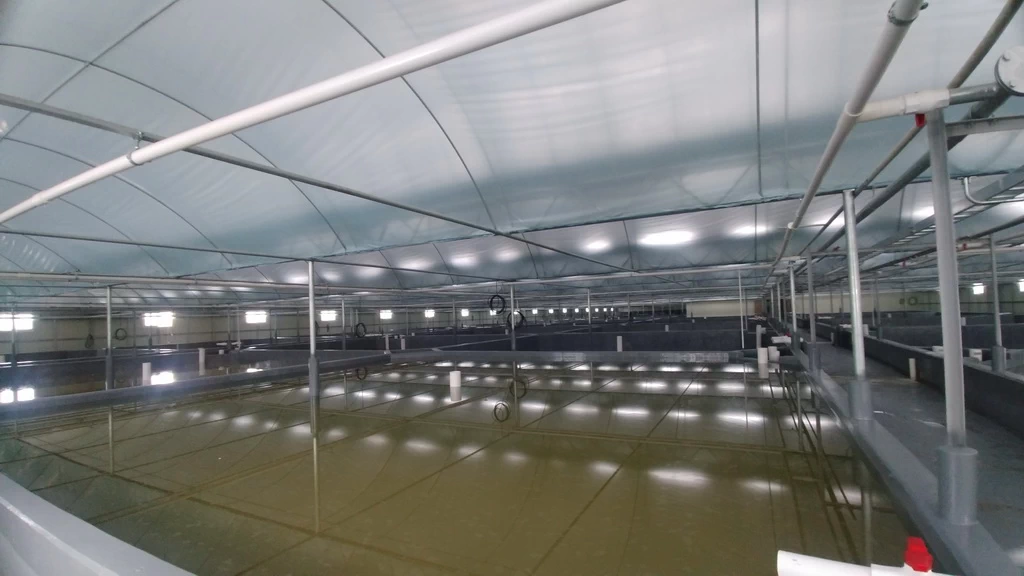
Effects of oxygen nanobubbles on aquaculture
Changes in survival, growth and water quality when nanobubbles are applied to culture tanks.
Key results
82%
Shrimp survival (clear water 40%)
Pacific white shrimp prenursery. Biofloc combined with ozone nanobubbles (Liang et al., 2025)
About 2×
Shrimp harvest and productivity
Pacific white shrimp, 81 days in an indoor raceway. Compared with diffuser aeration (Rahmawati et al., 2021)
65–67%
Relative percent survival
Nile tilapia challenged with a pathogen, ozone nanobubble treatment. Reported values 64.7–66.7% (Dien et al., 2021)
Our own field validation in aquaculture is in progress. Published research is presented first.
- Own cases
- Validation in progress
- Research cases
- 4
Results reported in published research
These are results from published research, not performance measured with Honour Tech products. We selected representative studies from peer-reviewed papers and public research reports and do not include corporate promotional material. Studies in which the effect was unclear are included as well. Last reviewed: October 2026.
Positive studies 3
-
82%
Shrimp survival
vs. 40% in clear-water culture. Result obtained in combination with biofloc.
82% shrimp survival with biofloc and ozone nanobubbles
vs. 40% in clear-water culture. Result obtained in combination with biofloc.
Paper details and results
Integration of Biofloc and Ozone Nanobubbles for Enhanced Pathogen Control in Prenursery of Pacific White Shrimp (Penaeus vannamei)
Combining biofloc and ozone nanobubbles to improve pathogen control in the nursery phase of whiteleg shrimp
- Citation
- Liang et al. · 2025 · Fishes 10(5), 218
- Summary
- Four rearing methods were compared in the nursery phase of whiteleg shrimp: clear water, clear water with ozone, biofloc, and biofloc with ozone.
- Key findings
- Compared with clear water, the combined biofloc and ozone nanobubble group showed a final body weight of 11.65 vs. 10.32 mg, 61% lower total ammonia nitrogen and 78% lower nitrite nitrogen, and Vibrio fell from 228,885 to 107 CFU/mL. Because these results come from use with biofloc, they cannot be attributed to ozone nanobubbles alone.
- Gas used
- Ozone (0.3 mg/L or higher, 15 minutes a day)
-
About 2×
Harvest · productivity
Pacific white shrimp, 81 days, vs. diffuser aeration
About 2× shrimp production with nanobubbles
Pacific white shrimp, 81 days, vs. diffuser aeration
Paper details and results
Enhancement of Penaeus vannamei shrimp growth using nanobubble in indoor raceway pond
Enhancement of Pacific white shrimp growth using nanobubbles in an indoor raceway pond
- Citation
- Rahmawati et al. · 2021 · Aquaculture and Fisheries 6(3), 277–282
- Summary
- Whiteleg shrimp were reared at high density (680/m³) for 81 days in a 50 ㎡ indoor raceway, comparing nanobubble supply with diffuser aeration.
- Key findings
- The nanobubble group showed survival of up to 95%, mean weight of 15.1 g, harvest of 436 kg and productivity of 8.7 kg/m³, with harvest and productivity reported as about double. Dissolved oxygen was significantly higher and feed conversion ratio lower. Mean bubble size was about 82 nm.
-
64.7–66.7%
Relative percent survival
Nile tilapia challenged with multidrug-resistant bacteria, ozone nanobubble treatment
Relative percent survival of 64.7–66.7% in infected tilapia treated with ozone nanobubbles
Nile tilapia challenged with multidrug-resistant bacteria, ozone nanobubble treatment
Paper details and results
Ozone nanobubble treatments improve survivability of Nile tilapia (Oreochromis niloticus) challenged with a pathogenic multi-drug-resistant Aeromonas hydrophila
Ozone nanobubble treatment improves survival of Nile tilapia infected with multidrug-resistant bacteria
- Citation
- Dien et al. · 2021 · Journal of Fish Diseases 44(9), 1435–1447
- Summary
- In a recirculating rearing system, Nile tilapia were infected with multidrug-resistant bacteria (Aeromonas hydrophila) and the effect of ozone nanobubble treatment was examined. In a 14-day safety test, no abnormal behavior or mortality occurred.
- Key findings
- Relative survival in the treated groups was 64.7–66.7%. Bacterial counts in rearing water fell 15.9–35.6% over the first two days in the treated groups and rose 13.1–27.9% in the untreated groups.
- Gas used
- Ozone
Neutral studies 1
-
No difference
Growth · survival · dissolved oxygen
Nitrite concentration was lower, 1.40 → 0.99 mg/L.
No difference in fish growth or survival with air nanobubbles
Nitrite concentration was lower, 1.40 → 0.99 mg/L.
Paper details and results
Air Nanobubbles Enhance Viable Bacteria Counts, Abundance of Nitrifying Bacteria, and Reduce Nitrite Levels in Marine Recirculation Aquaculture Systems
Air nanobubbles increase viable bacteria and nitrifying bacteria and lower nitrite in a seawater recirculating aquaculture system
- Citation
- Sean et al. · 2025 · Fishes 10(11), 550
- Summary
- Three fish species were reared for 6 weeks in two seawater recirculating aquaculture systems (RAS), comparing a system with air nanobubbles against one without.
- Key findings
- Growth rate, survival (95–100%), feed conversion ratio and dissolved oxygen showed no significant differences. Nitrite was lower with nanobubbles (0.99 vs. 1.40 mg/L), and nitrifying bacteria increased. The authors cited low stocking density and high water exchange as limitations.
- Gas used
- Air
Frequently Asked Questions
Which species have been studied?
We include studies on Pacific white shrimp, Nile tilapia and three marine fish species.
The studies cover shrimp survival and growth, tilapia survival, and water quality in recirculating aquaculture systems. Results vary with species, stocking density, water quality and operating conditions.
How do the ozone studies differ from the others?
The ozone studies address pathogen control; the others address dissolved oxygen, growth and water quality.
The ozone studies were carried out at set concentrations and treatment times, and conditions suited to each species must be confirmed separately before application. In studies combined with other treatments such as biofloc, the effect of nanobubbles alone is hard to separate.
When will Honour Tech's aquaculture field data be available?
Our own field validation is in progress.
We will publish the results on this page once they are compiled. Tell us the species, culture method and tank volume, and we will review a configuration suited to your site.
How were the studies selected?
We selected representative studies from peer-reviewed published papers.
We include 3 positive studies and 1 study with limited effect. These are not performance measurements of Honour Tech products, and the results come from experimental tanks or small-scale culture facilities.
Tell us your species, culture method, tank capacity and current dissolved oxygen, and we will review a configuration for your site.
Contact Us