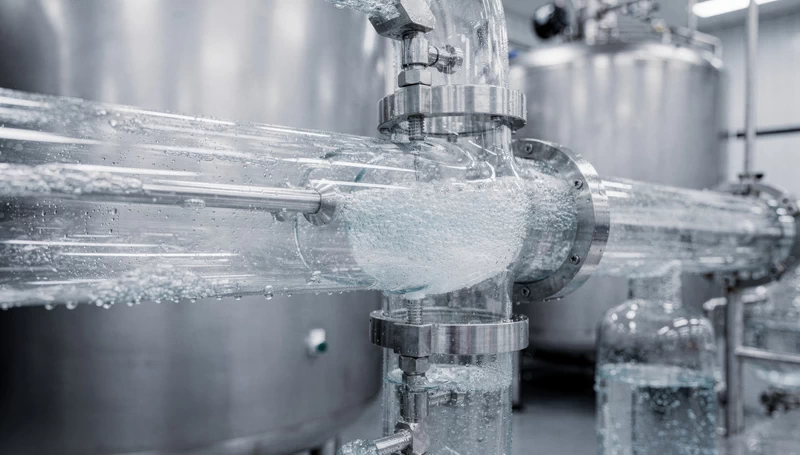
Research results on fine-bubble cleaning of equipment and pipes
A summary, based on published research, of fine-bubble cleaning applied to food manufacturing equipment surfaces, production pipes and CIP processes.
Key results
0.9 log₁₀
Additional biofilm reduction in pipes
Air bubble cleaning comparison in polypropylene pipe (Burfoot et al., 2017)
27–31%
Better cleaning efficiency for milk deposits
Stainless-steel heat transfer surface, specific pre-cleaning conditions (Chung et al., 2022)
31–72%
Better membrane flux recovery in CIP
UF pilot plant for milk filtration, microbubble-assisted CIP (Chung et al., 2023)
Our field application in equipment and pipe cleaning is under validation. Published research is presented first.
- Own cases
- Validation in progress
- Research cases
- 4
Published research on equipment and pipe cleaning
Four representative studies on food production equipment surfaces, pipe interiors and an actual CIP process. The results come from different bubble technologies and test conditions and are not validated figures for Honour Tech products.
Equipment and pipe surface cleaning 3
-
0.9 log₁₀
Additional pipe biofilm reduction
Air-bubble-entrained cleaning water vs. ordinary cleaning water
Additional 0.9 log₁₀ reduction of pipe biofilm with bubble-entrained cleaning water
Air-bubble-entrained cleaning water vs. ordinary cleaning water
Paper details and results
Assessing the effects of incorporating bubbles into the water used for cleaning operations relevant to the food industry
Assessing the effects of incorporating bubbles into the water used for cleaning operations relevant to the food industry
- Citation
- Burfoot, Limburn & Busby · 2017 · International Journal of Food Science & Technology 52(8), 1894–1903
- Test subject & method
- Biofilms and food soils on stainless-steel surfaces and polypropylene pipe interiors were compared with and without air bubbles in the cleaning water.
- Main results
- Under conditions with small bubbles (under 50 μm), biofilm removal improved by an additional 1.0 log₁₀ on stainless steel and 0.9 log₁₀ on pipe interiors. Cleaning of carbohydrate, fat and protein deposits was also evaluated.
- Interpretation & limits
- These are air bubbles, and the results depend on cleaning conditions and materials. They cannot be read as the effect of nanobubbles alone or as the cleaning performance of a specific product.
-
27–31%
Better cleaning efficiency for milk deposits
Heat transfer surface, specific low-temperature pre-cleaning conditions
Cleaning efficiency for milk deposits up 27–31% with microbubble-assisted cleaning
Heat transfer surface, specific low-temperature pre-cleaning conditions
Paper details and results
Microbubble-Assisted Cleaning To Enhance the Removal of Milk Deposits from the Heat Transfer Surface
Microbubble-assisted cleaning to enhance the removal of milk deposits from the heat transfer surface
- Citation
- Chung et al. · 2022 · ACS Sustainable Chemistry & Engineering 10(26), 8380–8387
- Test subject & method
- Microbubble-assisted cleaning was compared on milk deposits attached to stainless-steel heat transfer surfaces used in food processing.
- Main results
- A 27–31% improvement in cleaning efficiency was reported under specific experimental conditions (such as 25 °C).
- Interpretation & limits
- The effect varies with temperature, flow and other conditions, so the figures cannot be extended to an entire CIP process or to industrial residues in general.
-
About 4 log
Reduction of microorganisms in pipes
Plasma-activated microbubble water (PMBW)
About 4 log reduction of microorganisms in pipes with plasma-activated microbubble water
Plasma-activated microbubble water (PMBW)
Paper details and results
Inactivation and removal of Klebsiella michiganensis biofilm attached to the inner surfaces of piping by plasma-activated microbubble water (PMBW)
Inactivation and removal of Klebsiella michiganensis biofilm attached to the inner surfaces of piping by plasma-activated microbubble water (PMBW)
- Citation
- 2023 · Innovative Food Science & Emerging Technologies 86, 103360
- Test subject & method
- Plasma-activated microbubble water and comparison cleaning waters were tested on Klebsiella michiganensis biofilm inside PVC pipes.
- Main results
- Microorganisms in the pipe were reported to decrease by about 4 log CFU/cm² under PMBW flushing.
- Interpretation & limits
- The result combines chemical action from plasma activation with the action of bubbles and flow. It cannot be regarded as a result of ordinary water-based nanobubble cleaning.
CIP process application 1
-
31–72%
Better UF membrane flux recovery
7-step CIP in a milk filtration pilot
31–72% better UF membrane flux recovery with microbubble-assisted CIP
7-step CIP in a milk filtration pilot
Paper details and results
Microbubble-Assisted Cleaning-in-Place Process for Ultrafiltration System and Its Environmental Performance
Microbubble-assisted CIP process and environmental performance of an ultrafiltration system
- Citation
- Chung, Arbour & Huang · 2023 · Membranes 13(4), 424
- Test subject & method
- In a pilot UF system that processed milk, CIP using air microbubbles (average under 5 μm) in steps such as water rinsing and alkaline and acid cleaning was compared.
- Main results
- The membrane flux recovery indicator was 31–72% higher than with conventional CIP. A comparative life cycle assessment estimated a potential reduction in environmental impact of up to 37%.
- Interpretation & limits
- The difference in protein removal was not statistically significant, and the environmental impact is a life cycle assessment result, not a measured saving.
Frequently Asked Questions
Which equipment has been studied?
We include studies on production equipment surfaces, pipe interiors and CIP.
The results cover stainless-steel surfaces, polypropylene and PVC pipe interiors, and CIP of a UF plant for milk filtration. They cannot be applied directly to pharmaceutical, agrochemical or cosmetics equipment; site-specific contaminants and validation criteria must be checked.
Can bubbles eliminate cleaning chemicals?
Bubble-assisted studies alone do not support the conclusion that chemical cleaning can be replaced.
In the UF CIP study, air microbubbles were added to the cleaning solutions, but the alkaline and acid steps were kept. Reducing or replacing existing chemicals requires separate validation of residues, microorganisms and surface compatibility.
When will Honour Tech's field data be available?
Field application is under validation.
We will publish the results on this page once they are compiled. The suitability of equipment cleaning must be confirmed separately against your site's cleaning validation criteria.
How were the studies selected?
We selected 4 published studies directly related to the purpose of equipment and pipe interior cleaning.
We present both the cleaning-assist effect of bubbles and its limits, and the plasma-activated water study is kept separate. The results presented are data obtained under each research team's test conditions and are distinct from Honour Tech's in-house tests and field demonstrations.
Tell us the purpose, treatment flow rate, target water, and tank and pipe conditions, and we will review a site configuration.
Contact Us