0.9 log₁₀
Additional 0.9 log₁₀ reduction of pipe biofilm with bubble-entrained cleaning water
Air-bubble-entrained cleaning water vs. ordinary cleaning water
Research paper · Burfoot, Limburn & Busby · 2017
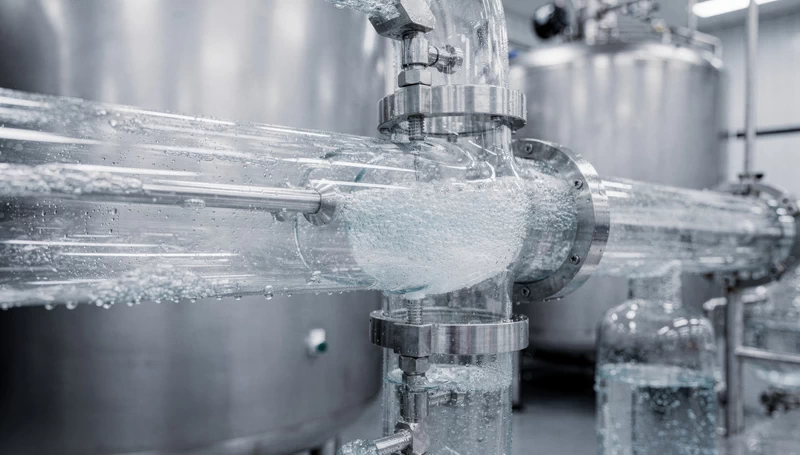
Nanobubbles are supplied to the cleaning and rinse water of WIP/CIP, tanks, piping and circulating water systems in production equipment sensitive to cross-contamination, such as pharmaceuticals, agrochemicals, cosmetics and food, supplementing the removal of residues inside tanks and pipes and helping stabilize cleaning quality.
In product changeovers, residues left inside tanks and pipes affect the quality of the next batch. Repeating cleaning or intensifying cleaning conditions adds to production schedules and chemical and water costs.
Residues left on tank walls and inside pipes during changeovers can affect the quality of the next batch and cross-contamination control.
Residues tend to remain where flow velocity is low or cleaning water is hard to reach, such as pipe bends and branches and internal tank structures.
Raising detergent concentration, cleaning time and rinse cycles increases chemical and water costs and wastewater load, and reduces production uptime.
For equipment and pipe cleaning, applicability is reviewed based on published research and process-specific technical conditions, and actual performance is evaluated through comparison tests applying the customer equipment's contaminant characteristics and existing cleaning acceptance criteria.
What Are NanobubblesNanobubble water supplements the action of existing cleaning solutions and circulation or spray flow, helping manage residues inside equipment, and can be used to improve both cleaning quality and operating conditions. There are no in-house quantitative tests yet for equipment and pipe cleaning, so all three effects are expected benefits to be confirmed by comparison tests on customer equipment.
Expected benefit
Expected benefit
Expected benefit
Applications are reviewed in four sub-fields: production equipment WIP/CIP, tanks and vessels, pipes and internal channels, and circulating water systems. Pipe and circulating water management is at the 'validation' stage; the other three are at the 'early market' stage.
Changeover cleaning of pharmaceutical, agrochemical, cosmetic and food production equipment
Inner walls of storage and mixing tanks, reactors and process vessels
Process piping, bends and branches, internal equipment channels
Managing fouling buildup and clogging in circulating water systems
The point where nanobubble water is supplied differs by cleaning method. This table shows both the configuration for connecting to existing equipment and the scope in which Honour Tech has confirmed effects through its own tests.
| Cleaning method | Main targets | Nanobubble water supply configuration | In-house validation scope |
|---|---|---|---|
| Circulation cleaning | Pipes, internal channels, closed-loop systems | Cleaning water in the circulation line supplied as nanobubble water | Separate validation required |
| Spray / WIP | Tank walls, vessel interiors | Supplied to the feed of spray balls and cleaning nozzles | Separate validation required |
| CIP | Pipe and tank cleaning cycles of production equipment | Supplied as CIP cleaning and rinse water | Process-specific validation required |
| Pulsed-flow-assisted cleaning | Bent and branched piping, nozzle cleaning processes | NPJ connected between the supply line and cleaning nozzles | NPJ application conditions and performance validation required |
CIP is a process concept that includes both circulation and spray cleaning, so the methods can overlap. Whether the system can be connected to existing equipment and whether cleaning actually improves are evaluated separately, and this table will be updated as tests progress.
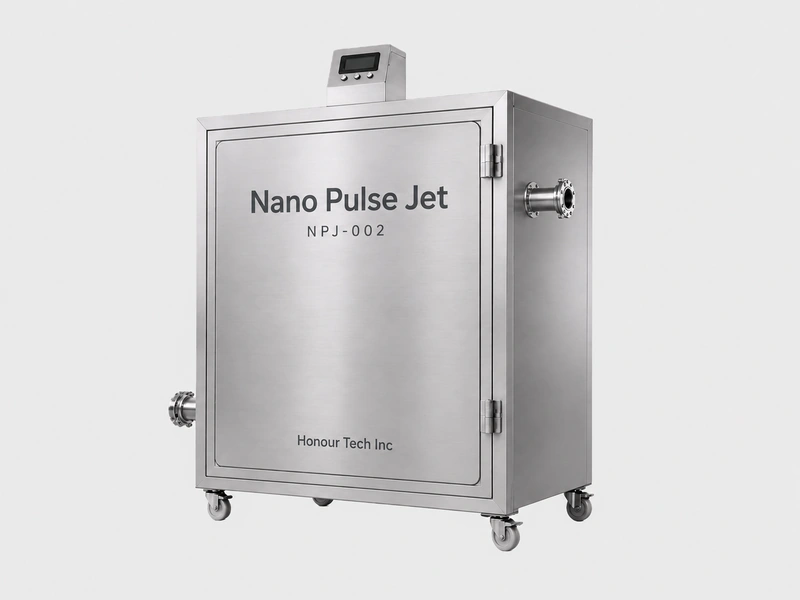
HQN is recommended for general process cleaning water supply, and HTV for production equipment where hygiene standards and wetted-part material control matter. The Nano Pulse Jet (NPJ) is selected separately from HQN and HTV for cleaning processes that need pulsed flow.
| Sub-application | HQN High density | HTV All SUS |
|---|---|---|
| Production equipment WIP/CIP | Optional | Recommended |
| Tank & vessel cleaning | Recommended | Optional |
| Pipe & internal channel cleaning | Recommended | Optional |
| Pipe & circulating water management | Recommended | |
| Details HQN | Details HTV |
Recommended Optional Tanks and piping in processes with hygiene standards, such as pharmaceuticals and food, follow production equipment WIP/CIP criteria. HTV's stainless steel wetted parts alone do not ensure GMP or hygiene compliance; material grade, surface finish and the customer's hygiene standards are checked as well. The Nano Pulse Jet (NPJ) applies to models of 5 m³/h or less and is selected after reviewing piping configuration, flow and pressure conditions.
Research papers on membrane and pipe cleaning with fine bubbles examine potential applications for cleaning time, recovery of pressure drop and pipe clogging. Honour Tech's field application in equipment and pipe cleaning is under validation, and test conditions and results for each study are available in the case studies.
0.9 log₁₀
Air-bubble-entrained cleaning water vs. ordinary cleaning water
Research paper · Burfoot, Limburn & Busby · 2017
31–72%
7-step CIP in a milk filtration pilot
Research paper · Chung, Arbour & Huang · 2023
Common questions about connection to existing WIP/CIP equipment, residues and scale, detergents and cleaning time, the Nano Pulse Jet and validation of cleaning effects.
The existing WIP/CIP system stays in place, and a nanobubble system is connected to the cleaning water supply line or circulation line to supply nanobubble water.
For tank cleaning, nanobubble water is generated from the cleaning water fed to the spray balls or nozzles; for pipe cleaning, from the cleaning water flowing through the circulation line. The connection point is set after checking the cleaning water tank, supply pump, piping layout and treatment flow rate.
Nano Pulse Jet (NPJ) connects between the existing cleaning water supply line and the cleaning nozzle, and can be used as a mobile unit shared among several systems or installed permanently on one line. NPJ is not an option common to all CIP systems, however, and is selected after reviewing piping configuration, flow rate and pressure conditions.
Nanobubble water can be considered as a way to complement the removal of contaminants attached inside pipes and tanks. Organic contaminants and hard mineral scale, however, require different removal methods.
For organic matter and relatively loosely attached residues, combining nanobubble water with suitable flow conditions can be considered to improve cleaning. Hard mineral scale such as calcium carbonate, on the other hand, is difficult to remove by physical cleaning alone and may require chemicals suited to its composition or a separate cleaning method.
Honour Tech checks the composition and adhesion of the contaminants, pipe material and internal structure to review the cleaning method, and judges feasibility through a preliminary comparison test if actual contaminant samples are available.
Combining nanobubble water with the existing CIP process can be considered to improve cleaning efficiency and optimize detergent use or cleaning time.
CIP cleaning performance is affected by detergent concentration, temperature, flow velocity, contact time and contaminant type, and nanobubble water is used as a means of complementing these conditions.
First, residue removal is compared between existing cleaning conditions and nanobubble conditions; once an effect is confirmed, detergent concentration or operating time is adjusted step by step. Any decision to reduce detergent concentration or cleaning time is made only after confirming that the cleaning results meet the existing acceptance criteria.
Nano Pulse Jet (NPJ) is a cleaning platform that combines nanobubble water with pulsed flow, unlike the ordinary approach of simply supplying nanobubble water.
Ordinary nanobubble cleaning improves cleaning performance by supplying nanobubble water to the item being cleaned. Nano Pulse Jet is designed to raise cleaning effectiveness inside equipment by combining the properties of nanobubble water with the mechanical action of pulsed flow.
For equipment with limited internal access, such as tanks and piping, application is reviewed according to contaminant adhesion, pipe geometry and pulse operating conditions, and actual performance is evaluated by comparison tests.
The cleaning effect is confirmed in the customer's process by comparing existing cleaning conditions with nanobubble conditions, using the existing cleaning acceptance criteria and methods.
Final rinse water TOC and conductivity, residue analysis and visual inspection are commonly used, and specific items and acceptance limits differ by process and product.
Improved cleaning and prevention of cross-contamination are not the same thing. Cross-contamination control is judged by the customer's residue acceptance limits and cleaning validation results, so Honour Tech designs comparison tests that also confirm whether nanobubble conditions meet existing validation criteria.
Tell us the equipment and contaminants to be cleaned, current cleaning method and acceptance criteria, and treatment flow, and we will review a comparison test method and site configuration with you.
Contact Us