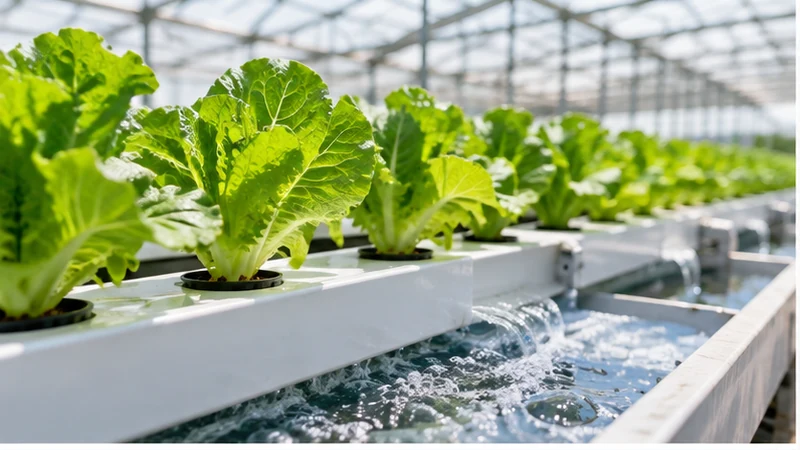
Nanobubbles in Agriculture
Oxygen nanobubbles are supplied to irrigation water for soil culture, hydroponics and smart farms to raise dissolved oxygen, improve the root zone and support stable crop growth and higher productivity.
How root-zone oxygen deficiency affects crop growth
In waterlogged soil, oxygen-poor substrates and warm-season nutrient solutions, normal root respiration is restricted, which can affect nutrient uptake and growth.
-
Lower respiration and energy production
When oxygen is short, aerobic respiration in the roots is restricted and fermentative metabolism increases in some tissues. Energy production becomes less efficient, and root function and growth can decline.
-
Reduced water and nutrient uptake
When roots lack energy, active nutrient uptake and water movement are affected, which can cause symptoms similar to nutrient deficiency or uneven growth.
-
Poorer root development and shoot growth
Prolonged oxygen deficiency restricts root elongation and new root development, and can also harm shoot growth and productivity.
Role of oxygen nanobubble irrigation
- Higher dissolved oxygen in irrigation water Water stored in the reservoir is circulated and treated with oxygen nanobubbles to raise dissolved oxygen.
- Better oxygen supply to the root zone The oxygen-enriched water reaches the roots through the existing nutrient supply equipment and irrigation piping.
Expected benefits of oxygen nanobubbles in agriculture
Oxygen nanobubble irrigation improves the oxygen supply to the root zone, supporting root development and crop growth. Honour Tech's in-house cultivation tests confirmed better root development and higher yields; improved marketability is being reviewed as an additional expected benefit.
-
Action
Root development and early establishment
- Supports root respiration and nutrient uptake
- Promotes root development
- Stable establishment and early growth after transplanting
Verified · In-house test (observed)
-
Field effect
Higher yield
- Higher yield from the same growing area
- Confirmed in pepper and fruit-vegetable cultivation tests
- Confirmed in a strawberry farm field trial
Verified · In-house test, field trial
-
Business effect
Better marketability
- Improved sugar content and firmness
- Larger share of premium grades
- Better selling prices and farm income
Expected benefit
Agricultural applications for oxygen nanobubbles
Applicable where water is held in a reservoir or nutrient tank before irrigation.
-
Soil culture
Open-field and greenhouse irrigation
-
Hydroponics & nutrient solution culture
Nutrient tanks and recirculating nutrient solution
-
Smart farms
Automated irrigation and nutrient control systems
- Commercial: field use and repeated supply
Nanobubble products for agriculture
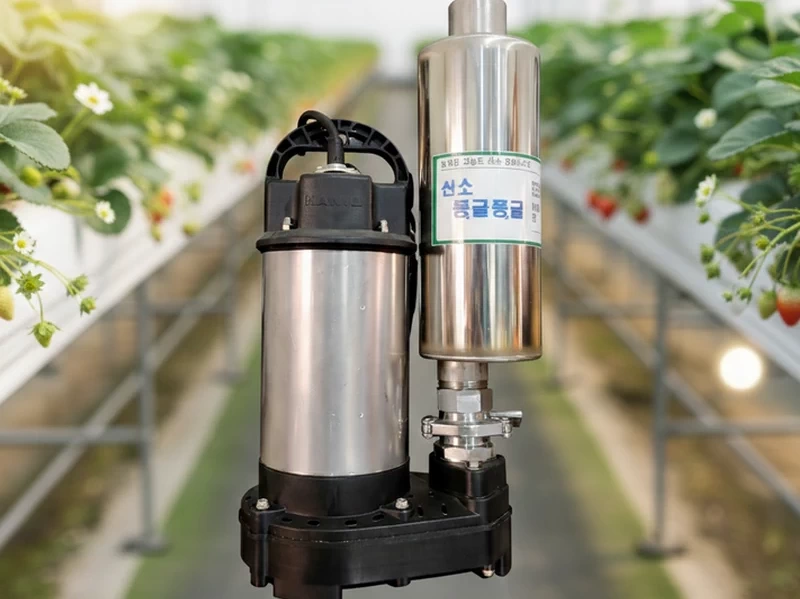
Honour Tech offers submersible-pump and surface-pump nanobubble systems depending on reservoir structure and capacity, irrigation volume and installation environment. The product line and operating mode can be chosen to suit site conditions.
| Sub-application | HOA Submersible pump | HEN Surface pump | HQN / HQN-OZ Booster pump |
|---|---|---|---|
| Soil culture | Recommended | Optional | Optional |
| Hydroponics & nutrient solution culture | Recommended | Optional | Optional |
| Smart farms | Recommended | Recommended | |
| Details HOA | Details HEN | Details HQN |
Recommended Optional (HQN-OZ is the ozone-only model)
Selection factors
- Whether the unit fits inside the reservoir (water depth, opening size)
- Reservoir capacity and irrigation volume per cycle
- Power supply (220 V single-phase, 380 V three-phase)
- Space for the equipment
- Water quality (consider HQN's ozone option if groundwater or surface water is contaminated)
Information to include in your inquiry
- Crop
- Reservoir capacity
- Irrigation volume per cycle
- Irrigation interval
Verified Cases
Key results from in-house cultivation tests and on-farm field trials.
30%+
Root development
Oriental melon · vs. control on day 24 after transplanting
In-house test · Observed
+3–58%
Yield
10 pepper and fruit-vegetable varieties · vs. control (May–Aug 2016)
In-house test · Measured
+15% or more
Strawberry yield
Seolhyang · greenhouse farm (Sep 2018–Apr 2019)
Field trial · Farm report
Frequently Asked Questions
Common questions about suitable crops, dissolved oxygen management, operating time, connection to existing equipment, and yield and economics.
Which crops benefit most from oxygen nanobubbles?
Oxygen nanobubbles improve the oxygen supply environment around the roots, and are especially valuable for crops and growing environments where oxygen shortage in the root zone limits growth.
Honour Tech has applied oxygen nanobubbles to and run cultivation trials on a wide range of fruit vegetables and greenhouse crops, including peppers, tomatoes, cucumbers, eggplants and strawberries.
Effects depend not only on the crop but also on the growing method (soil or nutrient solution culture), water temperature, substrate condition and irrigation conditions. Honour Tech therefore recommends setting oxygen supply conditions to suit the crop and growing environment.
Is higher dissolved oxygen always better? Can too much harm the crop?
Rather than simply maximizing dissolved oxygen, it is important to manage it at a level suited to the crop.
In ordinary soil cultivation, oxygen supply rarely causes problems in the root zone, but some greenhouse crops may respond negatively to high dissolved oxygen.
Honour Tech guides growers to set a suitable operating range after checking each crop's growth response. If negative responses to excessive oxygen supply are observed, supply can be paused temporarily and operating conditions adjusted after checking recovery.
For crops and growing environments that are particularly sensitive to dissolved oxygen, ordinary air nanobubbles can be considered as an alternative.
How many hours a day should an oxygen nanobubble system run?
Operating hours are set according to dissolved oxygen in the storage tank, irrigation volume and crop-specific management standards. Adjusting operating hours based on dissolved oxygen measurements allows more systematic oxygen supply management.
The required operating time varies with storage tank capacity, irrigation volume per cycle, irrigation interval, water temperature and oxygen consumption conditions.
Honour Tech can apply an operating method that sets a target dissolved oxygen range and switches the system on and off accordingly: the system starts when dissolved oxygen reaches the set lower limit and stops at the upper limit.
This makes it possible to manage the oxygen supply of irrigation water while reducing unnecessary continuous operation.
Do existing nutrient solution supply units or irrigation facilities need to be replaced?
In most cases, a nanobubble system can be added while the existing irrigation facilities continue to be used.
Typically, water in the irrigation storage tank or nutrient tank is circulated through the nanobubble system, and the oxygenated water is delivered to the crop through the existing nutrient supply unit and irrigation piping.
The submersible pump type suits sites where it can be installed inside the storage tank, while the transfer pump type is installed outside the tank and connected by piping.
Honour Tech checks storage tank capacity and structure, irrigation volume, installation space and power conditions to propose a suitable product series and installation method.
How much can yield increase with oxygen nanobubbles, and how quickly can the investment be recovered?
Honour Tech's own cultivation trials confirmed yield increases depending on the crop and test conditions, and there are cases where farms have confirmed the economic benefit in practice.
One farm in Jinju, South Gyeongsang Province, which has grown greenhouse strawberries for more than 20 years (about 1,000 pyeong, roughly 3,300 m²), said in an interview that its income rose by more than KRW 40 million compared with previous years after adoption. The farm first installed the system at one of its two farms and later installed it at the other.
Some strawberry and rose growers operate several farms (as many as six), and what they have in common is that they installed the system at one farm first, confirmed the effect, and then extended it to the rest. About 15% of purchasing farms have installed two or more units.
However, the degree of improvement depends on the crop and growing environment, so one farm's results cannot be applied equally to every farm. Economics are calculated by considering equipment cost, power and oxygen costs, growing area, existing yield and selling price. Honour Tech reviews the customer's crop, growing area, reservoir capacity and irrigation conditions and provides the information needed for an economic assessment.
Tell us your crop, tank capacity, irrigation volume per cycle and irrigation interval, and we will propose a configuration for your site.
Contact Us