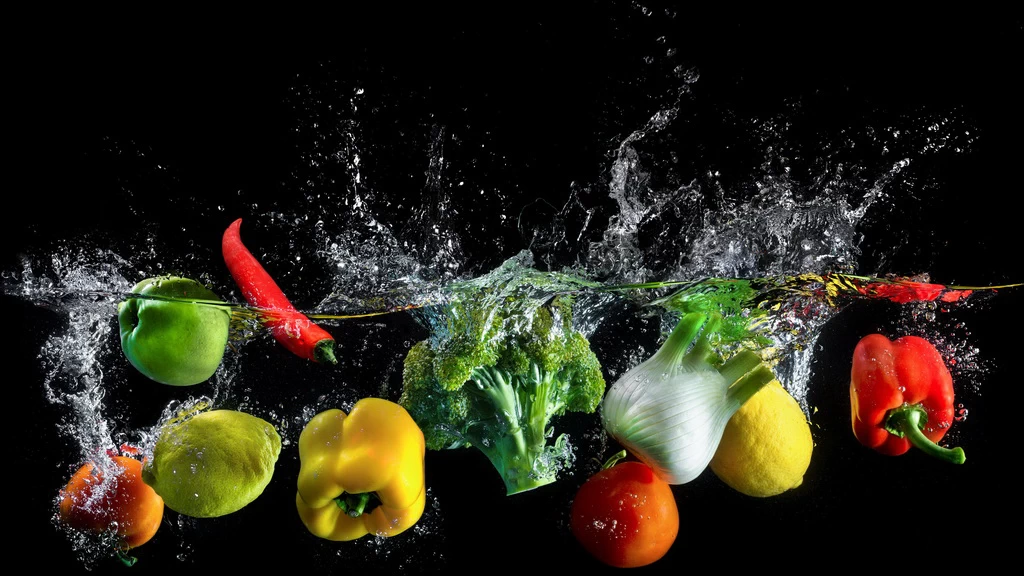
Effects of nanobubbles on food washing
Changes in microorganisms and residues when produce and food are washed with fine bubbles.
Key results
77.3%
Pesticide removal
Apple. Air micro-nanobubbles combined with an antimicrobial (Lu et al., 2025)
+15–47%
Pesticide removal
Cowpea. Ozone microbubbles vs. conventional ozone bubbles (Li et al., 2023)
4 log or more
Bacterial reduction
Tomato, 30-second wash with ozone microbubble water. Vs. water wash; reported values 4.11–4.83 log (Hou et al., 2022)
Our own tests in produce and food washing are in progress. Published research is presented first.
- Own cases
- Validation in progress
- Research cases
- 4
Results reported in published research
These are results from published research, not performance measured with Honour Tech products. We selected representative studies from peer-reviewed papers and public research reports and do not include corporate promotional material. Studies in which the effect was unclear are included as well. Last reviewed: October 2026.
Positive studies 3
-
77.3%
Pesticide removal from apples
Bacteria and yeasts reduced by more than 3 log. Result obtained in combination with an antimicrobial.
77.3% pesticide removal from apples with air micro/nanobubbles and an antimicrobial
Bacteria and yeasts reduced by more than 3 log. Result obtained in combination with an antimicrobial.
Paper details and results
Decontamination of fresh apples using air micro-nanobubbles with epsilon-poly-lysine
Decontamination of apples using air micro-nanobubbles and ε-polylysine
- Citation
- Lu et al. · 2025 · Food Innovation and Advances 4(4), 446–453
- Summary
- Apples inoculated with Listeria, spoilage yeast and a pesticide (trichlorfon) were washed with air micro-nanobubble water combined with an antimicrobial (ε-polylysine 250 mg/L) and compared with each treatment alone.
- Key findings
- The pesticide removal of 77.3% was significantly higher than with either treatment alone, and quality after 20 days of storage did not differ. This removal rate was obtained with nanobubbles and the antimicrobial combined; the contribution of each was not evaluated separately.
- Gas used
- Air
-
+15–47%
Additional removal of 5 pesticides
Cowpea, vs. conventional ozone bubbles. A microbubble study.
Pesticide removal up an additional 15–47% with ozone microbubble washing
Cowpea, vs. conventional ozone bubbles. A microbubble study.
Paper details and results
Accelerated removal of five pesticide residues in three vegetables with ozone microbubbles
Accelerated removal of five pesticide residues in three vegetables with ozone microbubbles
- Citation
- Li et al. · 2023 · Food Chemistry 403, 134386
- Summary
- Celery, bok choy and cowpea sprayed with 5 pesticides in the field were washed with ozone microbubbles or conventional ozone bubbles, and removal rates were compared.
- Key findings
- Overall removal from cowpea was relatively low at 28–65%, which the authors attributed to the surface structure of the crop. This is a microbubble study, and statistical significance was not reported.
- Gas used
- Ozone
-
4.11–4.83 log
Bacterial reduction on tomatoes
Vs. water wash. Ozone microbubble water
Bacteria on tomatoes reduced by 4.11–4.83 log with ozone microbubble water washing
Vs. water wash. Ozone microbubble water
Paper details and results
Antibacterial Efficacy and Physiochemical Effects of Ozone Microbubble Water on Tomato
Antibacterial efficacy and physicochemical effects of ozone microbubble water on tomato
- Citation
- Hou et al. · 2022 · Sustainability 14(11), 6549
- Summary
- Tomatoes inoculated with 4 foodborne pathogens were washed for 30 seconds with ozone microbubble water (bubbles 3.84–11.99 μm) and compared with washing in water, microbubbles alone and ozone alone.
- Key findings
- Bacterial counts were 3.37–4.50 log lower than with ozone alone and 2.09–2.82 log lower than with microbubbles alone. Texture and aroma did not differ. Dissolved ozone in the ozone microbubble water (over 10 mg/L) was much higher than in the ozone-only water (about 2 mg/L), so the effect of the bubbles is mixed with that of ozone concentration.
- Gas used
- Ozone
Neutral studies 1
-
No significant difference found
Oxygen nanobubbles alone
Bacteria were significantly reduced only when combined with ultrasound.
No bacterial reduction found with oxygen nanobubble washing alone
Bacteria were significantly reduced only when combined with ultrasound.
Paper details and results
The Effect Ultrasound and Surfactants on Nanobubbles Efficacy against Listeria innocua and Escherichia coli O157:H7, in Cell Suspension and on Fresh Produce Surfaces
Effect of ultrasound and surfactant on bacterial reduction by nanobubbles: bacterial suspensions and produce surfaces
- Citation
- Rafeeq, Ovissipour · 2021 · Foods 10(9), 2154
- Summary
- Two bacteria in suspension and on spinach leaves were treated with oxygen nanobubbles, ultrasound, both combined, and with added surfactant.
- Key findings
- In suspension, nanobubbles alone or ultrasound alone produced no significant reduction even after 15 minutes. Combined, they removed more than 2 log of Listeria and more than 4 log of E. coli from spinach. Adding surfactant did not significantly increase the effect.
- Gas used
- Oxygen
Frequently Asked Questions
Which produce has been studied?
We include studies on apples, tomatoes, three vegetables and spinach.
The studies address changes in bacterial counts and pesticide residues. Results vary with the type and surface condition of the produce, the contaminants and the washing conditions.
Which approaches had the largest effect?
The effect was largest when bubbles were combined with ozone, an antimicrobial or ultrasound.
One study reported that water with bubbles alone did not reduce bacteria. In the ozone studies, the effect of the bubbles is mixed with that of ozone concentration.
When will Honour Tech's test data be available?
Our own tests are in progress.
We will publish the results on this page once they are compiled. Tell us what you wash and how water is supplied, and we will propose a configuration suited to your site.
How were the studies selected?
We selected representative studies from peer-reviewed published papers.
We include 3 positive studies and 1 study with limited effect. These are not performance measurements of Honour Tech products, and most of the studies address microbubbles or micro-nanobubbles.
Tell us what you wash, how water is supplied and your hourly water use, and we will propose a configuration suited to your site.
Contact Us